
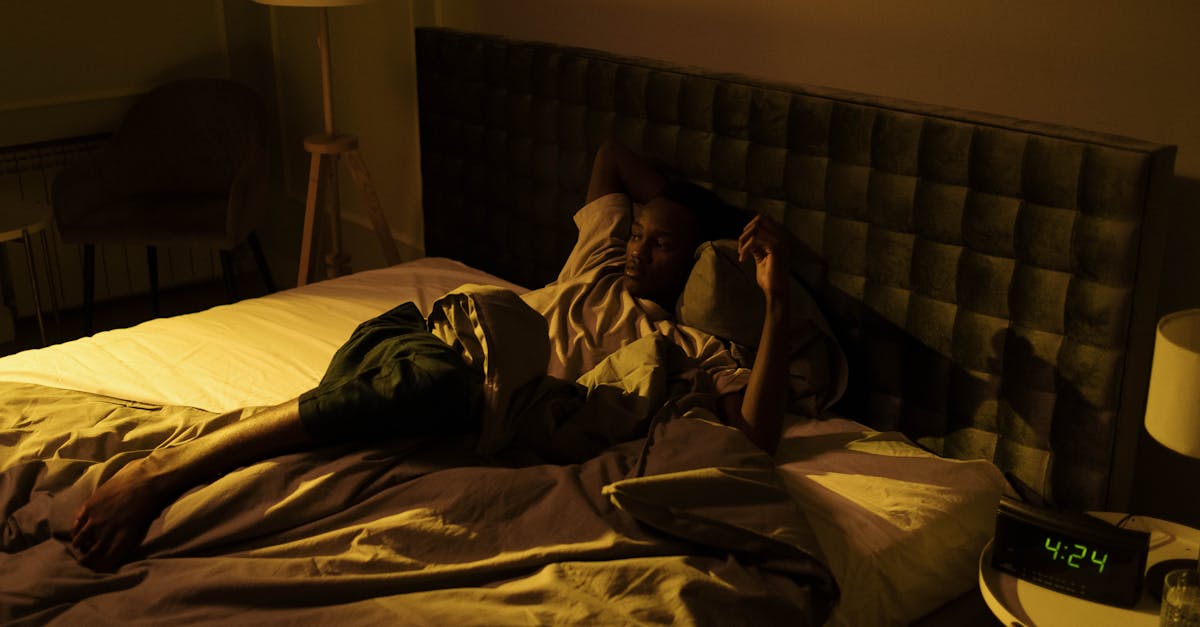
You can train yourself to fall asleep faster. Normal sleep latency — the time it takes to fall asleep — ranges from ten to twenty minutes. If you’re consistently lying awake longer, the problem is usually trainable, not medical. Most people who can’t fall asleep don’t have a sleep disorder; they have a nervous system stuck in overdrive, a misaligned body clock, or a bed that’s become associated with wakefulness instead of sleep.
This guide teaches you evidence-based techniques from cognitive behavioral therapy for insomnia (CBT-I) and circadian biology. You’ll learn how to calm a racing mind, align your circadian rhythm, and retrain your body to recognize bedtime as sleep time.
What you’ll need
No tools or purchases required. These techniques rely on behavior change, not products.
Prerequisites:
- Willingness to track your sleep timing for one to two weeks
- Ability to control bedroom temperature (or use a fan)
- Access to bright outdoor light in the morning (or a 10,000-lux light box if needed)
- Fifteen minutes daily for worry-time practice (initially)
Before you start
These techniques are for people whose sleep latency is consistently longer than twenty minutes but who don’t have diagnosed sleep disorders like sleep apnea or restless leg syndrome. If you’ve been lying awake for more than thirty minutes at least three nights a week for three months or longer, that meets the clinical definition of sleep-onset insomnia, and you should see a sleep medicine specialist. If your racing mind is accompanied by daytime panic or persistent anxiety, talk to a mental health professional — sleep problems and anxiety disorders often require coordinated treatment.
The techniques below are behavioral interventions from CBT-I, the gold-standard treatment for insomnia. Psychological and behavioral treatments show strong evidence for improving sleep onset. Gains persist long-term, and many people see clinically meaningful improvement with consistent practice.
Which problem do you have? A self-diagnosis shortcut
Before you try every technique, identify which one matches your pattern:
Sleep pressure deficit: “I’m tired but not sleepy. I lie in bed for nine hours but only sleep six.” → Start with Step 2: Sleep restriction
Circadian misalignment: “I’ve always been a night owl. I naturally fall asleep at 1 AM but need to wake at 7 AM.” → Start with Step 3: Morning light
Conditioned arousal / racing mind: “I was exhausted on the couch, but the moment I got into bed, my mind started racing.” → Start with Step 5: Stimulus control and Step 6: Cognitive offloading
Matching the right technique to your pattern speeds up results. If you’re unsure, try sleep restriction first — it builds the biological foundation that makes the other techniques work better.
Step 1: Understand why you can’t fall asleep
Sleep onset requires three conditions: enough sleep pressure (the biological drive to sleep), a body clock aligned with your intended sleep time, and a calm nervous system. If any one is missing, you lie awake.
Sleep pressure builds steadily throughout the day. If you spend too much time in bed awake — napping, or lying in bed for nine hours when you only sleep six — your sleep pressure at bedtime is weak, and you won’t feel sleepy even though you’re tired.
Circadian misalignment happens when your internal body clock says it’s mid-afternoon but the clock on the wall says bedtime. This is common in people who get little morning light, use screens late into the evening, or have a naturally late chronotype. Your brain isn’t ready for sleep because it hasn’t received the environmental cues that signal nighttime.
Nervous system activation — the “racing mind at night” — is often daytime stress leaking into bedtime plus worry about sleep itself. This creates a feedback loop: you worry you won’t sleep, which activates your nervous system, which prevents sleep, which gives you more reason to worry. This conditioned arousal is one of the most common reasons people can’t fall asleep fast even when they’re exhausted.
Once you know which condition is the problem, you can match the right technique to fix it.
Step 2: Build sleep pressure with sleep restriction
If you’re spending eight or nine hours in bed but only sleeping six, your sleep is fragmented and your sleep pressure at bedtime is too low. Sleep restriction therapy consolidates your sleep by limiting your time in bed to match your actual sleep time.
How it works: Track your sleep for one week. Calculate your average total sleep time (only time asleep, not time in bed). Set your bedtime so that your time in bed equals your average sleep time plus thirty minutes. For example, if you sleep an average of six hours, allow yourself six and a half hours in bed. Go to bed later, but wake at the same time every day.
This sounds counterintuitive, but restricting time in bed increases sleep pressure, which makes you fall asleep faster and sleep more deeply. After one to two weeks, if you’re sleeping more than eighty-five percent of your time in bed, extend your bedtime by fifteen minutes. Repeat until you’re sleeping seven to eight hours without long awake periods.
Timeline: Most people see noticeable improvement in sleep latency within two to four weeks. The first week may feel rough as your body adjusts.
Step 3: Use morning light to shift your body clock

If your circadian rhythm is delayed — your body naturally wants to sleep and wake later than your schedule requires — you’ll lie awake at night because your brain genuinely isn’t ready for sleep yet.
How it works: Get thirty minutes of bright light exposure (10,000 to 30,000 lux) within thirty to one hundred twenty minutes of your desired wake time. This timing window matters — light exposure during this early window most effectively advances your circadian phase. Outdoor light is ideal; even an overcast morning is far brighter than indoor lighting. If outdoor light isn’t practical, a 10,000-lux light therapy box works. Sit twelve to eighteen inches from the box while you have coffee or check email.
This advances your circadian phase, shifting your internal clock earlier so your brain is ready for sleep when you want to go to bed. The effect strengthens over five to seven days.
In the evening: Keep light dim (under one hundred lux if possible) for one to two hours before bed. Bright light in the evening delays your circadian rhythm, which is why screens before bed push your sleep later. If you must use screens, switch to red-light mode or wear blue-light-blocking glasses. Better: read a paper book or listen to an audiobook in dim light.
For more on circadian timing, see sleep schedule fix.
Step 4: Cool your bedroom to trigger sleep onset
Your core body temperature naturally drops as you prepare for sleep. If your room is too warm, your body can’t complete this process efficiently, and sleep onset is delayed.
Target temperature: Sixty-five to sixty-eight degrees Fahrenheit (eighteen to twenty degrees Celsius) is optimal for most people, though individual variation exists. Some need it a few degrees warmer. Experiment within that range.
Mechanism: Cooling your room allows peripheral vasodilation — blood vessels in your hands and feet dilate, releasing heat from your core. This signals your brain that it’s time to sleep. If you’re wrapped in heavy blankets in a warm room, you trap heat and prevent this signal.
Practical tip: If you can’t control your bedroom temperature, use a fan, sleep with one foot out of the blankets, or take a warm shower sixty to ninety minutes before bed. The shower raises your core temperature temporarily; when you cool down afterward, it accelerates the natural temperature drop your body needs for sleep.
Timeline: You’ll feel the effect within fifteen to thirty minutes if temperature was the bottleneck.
Step 5: Retrain your bed association with stimulus control
If you lie in bed awake for long stretches — scrolling your phone, worrying, trying to force sleep — your brain learns that bed equals wakefulness. This conditioned arousal is why some people feel wide awake the moment they get into bed even though they were drowsy on the couch.
How to fix it — the twenty-minute rule: Use your bed only for sleep (and sex). No reading, no scrolling, no working. If you’re not asleep within twenty minutes, leave the bed. Go to another room and do something calm and boring in dim light (read a dull book, fold laundry), then return to bed only when you feel sleepy again. Repeat as many times as needed.
Why twenty minutes matters: This threshold prevents you from lying awake long enough for your brain to strengthen the bed-wakefulness association. The behavioral loop you’re breaking is: bed → lying awake → frustration → more arousal → more wakefulness. By leaving after twenty minutes, you interrupt this loop before it cements. Your brain re-learns that bed is where sleep happens, not where you lie awake.
Timeline: Most people see a shift within one to two weeks of consistent practice.
Step 6: Calm a racing mind with cognitive offloading

A racing mind at night is often worry leaking from the day plus metacognitive anxiety (“I’ll never fall asleep, and tomorrow will be terrible”). This activates your nervous system and creates a feedback loop that keeps you awake.
Worry time (fifteen-minute cognitive offload): One to two hours before bed, sit down with a notebook and spend fifteen minutes writing down everything on your mind. Tomorrow’s tasks, things you’re worried about, unresolved thoughts. Be specific. You don’t have to solve anything — just externalize it. This tells your brain, “This is handled. It’s not a bedtime task.”
Why it works: Worry offloading reduces intrusive thoughts by externalizing the mental loop. Writing it down creates a sense of completion that quiets the monitoring system that keeps poking you with “don’t forget this.”
Metacognitive shift: When you’re lying in bed and notice racing thoughts, don’t fight them. Shift to a neutral frame: “I’m resting. My body is still getting rest even if I’m not asleep yet.” Catastrophizing about wakefulness (“This is terrible, I’ll be exhausted tomorrow”) increases arousal. Neutral acceptance reduces it.
Why this matters: The attention-intention-effort model shows that trying too hard to sleep backfires. The goal is to be restful, not to force sleep.
If your racing mind is part of a broader anxiety pattern, see sleep anxiety for more context on when bedtime worry signals a clinical concern.
The evening routine that works
Here’s how to layer these techniques into a functional evening:
-
Three to four hours before bed: Last caffeine cutoff. Caffeine has a half-life of five to six hours in most people, which means if you have caffeine at 2 PM, half of it is still in your system at 7 or 8 PM. For an 11 PM bedtime, cut off caffeine by 2 to 3 PM. Individual metabolism varies, so adjust based on your sensitivity. Learn more at caffeine sleep.
-
One to two hours before bed: Dim the lights. If you must use screens, switch to red-light mode or wear blue-blocking glasses. Read more at blue light sleep.
-
One to two hours before bed: Do your fifteen-minute worry offload if you anticipate a racing mind.
-
Thirty to sixty minutes before bed: Wind down with a boring, non-stimulating activity in dim light. No work, no arguments, no doom-scrolling.
-
At bedtime: Cool room (sixty-five to sixty-eight degrees Fahrenheit). Get into bed only when sleepy. If not asleep in twenty minutes, leave the bed (stimulus control). Repeat as needed.
-
Morning: Wake at the same time every day, even weekends. Get thirty minutes of bright light within thirty to one hundred twenty minutes of waking.
This sequence builds sleep pressure, aligns your circadian rhythm, prevents nervous system activation, and retrains your bed association. Consistency matters more than perfection.
Verify it worked
Track your sleep latency (time to fall asleep) for two weeks. You should see:
- Sleep latency dropping toward ten to twenty minutes
- Fewer middle-of-the-night wake-ups
- Feeling sleepy at your intended bedtime (not wired)
- Less anxiety about sleep itself
If sleep latency improves but you’re waking frequently, you may have a different issue like sleep apnea or periodic limb movement disorder. See a sleep specialist.
Troubleshooting
Problem: I’m doing everything right but still lying awake forty-five minutes.
Likely cause: Sleep restriction may not be aggressive enough, or you’re trying too hard to sleep (metacognitive effort). Double-check that your time in bed matches your actual sleep time. If you’re lying in bed “resting” for an hour before sleep, that counts as time in bed, and it fragments sleep pressure.
Problem: I fall asleep fast but wake up at 3 AM with a racing mind.
Likely cause: This is middle-insomnia, not sleep-onset insomnia. The worry-offload technique still helps, but you may also need to address nighttime cortisol or blood sugar. This is beyond the scope of this article; see a sleep medicine provider.
Problem: Morning light makes me feel more alert, but I’m still not sleepy at night.
Likely cause: You may also need evening light restriction. If you’re getting bright light until 10 PM (screens, overhead lights), it cancels out the morning signal. Dim your environment starting two hours before bed.
Problem: I travel across time zones frequently. Does this still work?
Likely cause: Circadian alignment is harder with frequent travel. The morning-light technique still works, but you’ll need to adjust the timing to your destination time zone immediately. This is jet lag management, not chronic insomnia.
When to call a professional
See a sleep medicine specialist if:
- Sleep latency is consistently over thirty minutes, at least three nights per week, for three months or more
- You suspect sleep apnea (snoring, gasping, daytime fatigue despite “enough” sleep)
- Racing thoughts are accompanied by panic attacks, uncontrollable worry, or suicidal thoughts
- You’ve tried these techniques consistently for six to eight weeks with no improvement
- You’re considering starting a supplement or sleep medication and want to understand risks and interactions
CBT-I is often delivered by psychologists or sleep medicine clinics and is covered by many insurance plans. The CDC recommends behavioral interventions as first-line treatment for chronic insomnia.
FAQ
How long should it take to fall asleep?
Normal sleep latency ranges from ten to twenty minutes. Consistently longer suggests sleep-onset insomnia or circadian misalignment. Consistently shorter (under five minutes) may indicate sleep debt — you’re so exhausted that you crash immediately, which isn’t the same as healthy sleep.
What’s the fastest way to fall asleep?
It depends on what’s blocking you. If it’s a racing mind, cognitive offloading can work within the same night. If it’s circadian misalignment, morning light takes five to seven days. If it’s conditioned arousal, stimulus control takes one to two weeks. There’s no universal fastest fix — match the technique to the cause.
Can you train yourself to fall asleep faster?
Yes. Behavioral interventions reduce sleep latency in most people who practice them consistently. Sleep onset is a trainable skill, not a fixed trait. The techniques in this article come directly from CBT-I protocols.
Why do I lie awake for hours even though I’m exhausted?
Being tired and being sleepy are different. Tiredness is fatigue; sleepiness is biological sleep pressure. If you’re tired but wired, your nervous system is activated (stress, worry, or conditioned arousal) or your circadian rhythm is misaligned. You need to address the activation, not just rest more.
Does magnesium help you fall asleep faster?
Magnesium glycinate shows modest benefit in small studies, mostly in people with low magnesium levels. It’s not a magic solution. If you’re considering it, dosing typically ranges from two hundred to four hundred milligrams one to two hours before bed, and effects are subtle over several weeks, not immediate. Evidence for general insomnia is weak. Talk to your doctor before starting any supplement.
What about melatonin?
Melatonin is modestly effective for jet lag and shift work but evidence for general sleep-onset insomnia is limited. If you try it, typical doses range from half a milligram to three milligrams (not ten milligrams) one to two hours before bed. Timing matters more than dose. Consult your doctor before use, especially if you’re on other medications.
Sleep latency is trainable. Most people who can’t fall asleep don’t need medication or expensive gadgets — they need to align their circadian rhythm, calm their nervous system, and retrain their bed association. Give these techniques six to eight weeks of consistent practice. If they don’t work, see a sleep specialist for a formal evaluation.
For general information only and not a substitute for professional medical advice. If sleep problems persist or worsen, consult a sleep medicine specialist or mental health provider.